Project Layout 1.4.2-SNAPSHOT API
Project Layout
Project Layout is a small utility library for describing and working with conventional project directory layouts—including sources, resources, tests, and documentation—in a consistent way. It is intended for build tooling and plugins that need to locate well-known folders reliably across different projects. Project Layout supports all types of project files, including source code, documentation, project site content, and other relevant files.
Architecture and behavior
The API has two cooperating layers. ProjectLayoutManager detects the
project type and creates a configured ProjectLayout, while
ProjectProcessor provides reusable recursive processing of a project
and its discovered modules. The layout abstraction keeps consumers independent
of build-system-specific metadata and path conventions.
ProjectLayoutManager checks pom.xml,
build.gradle, package.json, and
pyproject.toml, in that order, and selects the matching Maven,
Gradle, JavaScript/TypeScript, or Python implementation. An existing directory
without a recognized descriptor uses the filesystem-based
DefaultProjectLayout; a missing directory is rejected.
Every ProjectLayout is configured with a project root and exposes
root-relative locations for production sources, tests, and documentation, as
well as module and project identity information where the underlying metadata
supplies it. Maven layouts read POM build roots, resources, coordinates, parent
information, and modules. Gradle layouts use the Tooling API for project and
child-module names and conventional source roots. JavaScript/TypeScript layouts
discover array-form package workspaces, and Python layouts recognize public
named projects declared in pyproject.toml. The default layout uses
filesystem conventions. Callers should resolve returned path strings against the
configured project root.
To process a repository, extend ProjectProcessor and implement its
folder-processing operation. The processor applies that operation to a leaf
project, or traverses the modules reported by a parent layout. This makes one
operation reusable across a repository and its discovered child projects. A
null module list identifies a leaf and invokes the processing hook;
an empty module list identifies a parent with no modules and does not invoke it.
Principal types
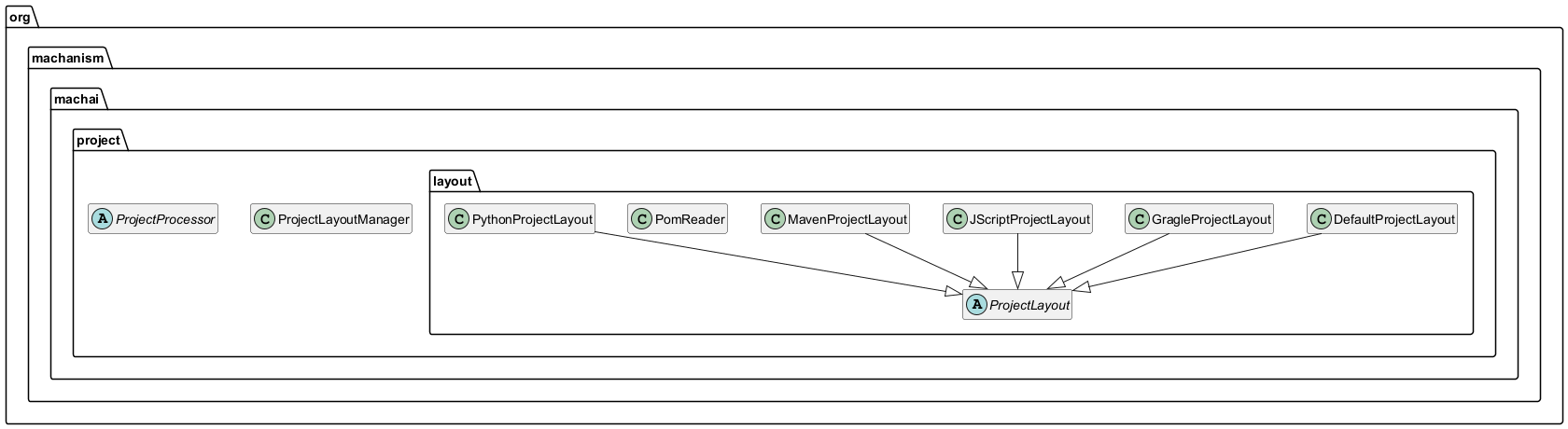
The following class diagram shows the principal detection, processing, and layout
types. It illustrates how ProjectLayoutManager and
ProjectProcessor use the common ProjectLayout abstraction
and its Maven, Gradle, JavaScript/TypeScript, Python, and default implementations.
Packages
- org.machanism.machai.project
-
Coordinates project-layout detection and caller-defined recursive processing of
projects and their modules.
ProjectLayoutManagerselects a layout using deterministic descriptor precedence, andProjectProcessorsupplies the traversal workflow and processing extension point. - org.machanism.machai.project.layout
-
Defines the common project-layout abstraction, Maven, Gradle,
JavaScript/TypeScript, Python, and fallback implementations, and Maven
descriptor support. Layouts provide root-relative source, test, and
documentation locations, metadata-derived identity, module discovery where
supported, and shared filesystem utilities.
PomReaderparses and serializes Maven models.