


GenAI Client


Overview
GenAI Client is a Java library designed for integrating Machai applications with generative AI providers through a consistent provider abstraction. It provides provider resolution, prompt and instruction handling, runtime configuration, optional embedding generation, usage tracking, and Java function-tool, prompt, and resource registration for AI-powered workflows.
The library is organized around the common ProcessProvider lifecycle contract and shared provider infrastructure. Applications can resolve a configured provider from identifiers such as OpenAI:gpt-4o-mini, attach prompts, system instructions, tools, resources, web-search support, or MCP servers, and execute requests without depending directly on vendor-specific SDK details. Token usage is captured in immutable usage records and can be aggregated per model for reporting and diagnostics.
GenAI Client also includes a lightweight tool metadata layer. Java methods annotated as tools, prompts, or resources can be discovered through ServiceLoader, described with parameter metadata, filtered for supported application classes, and registered with providers as AI-callable functions or resource callbacks. This enables advanced use cases such as semantic search, automated content generation, intelligent project assembly, structured tool execution, local tool orchestration, and provider-independent prompt workflows.
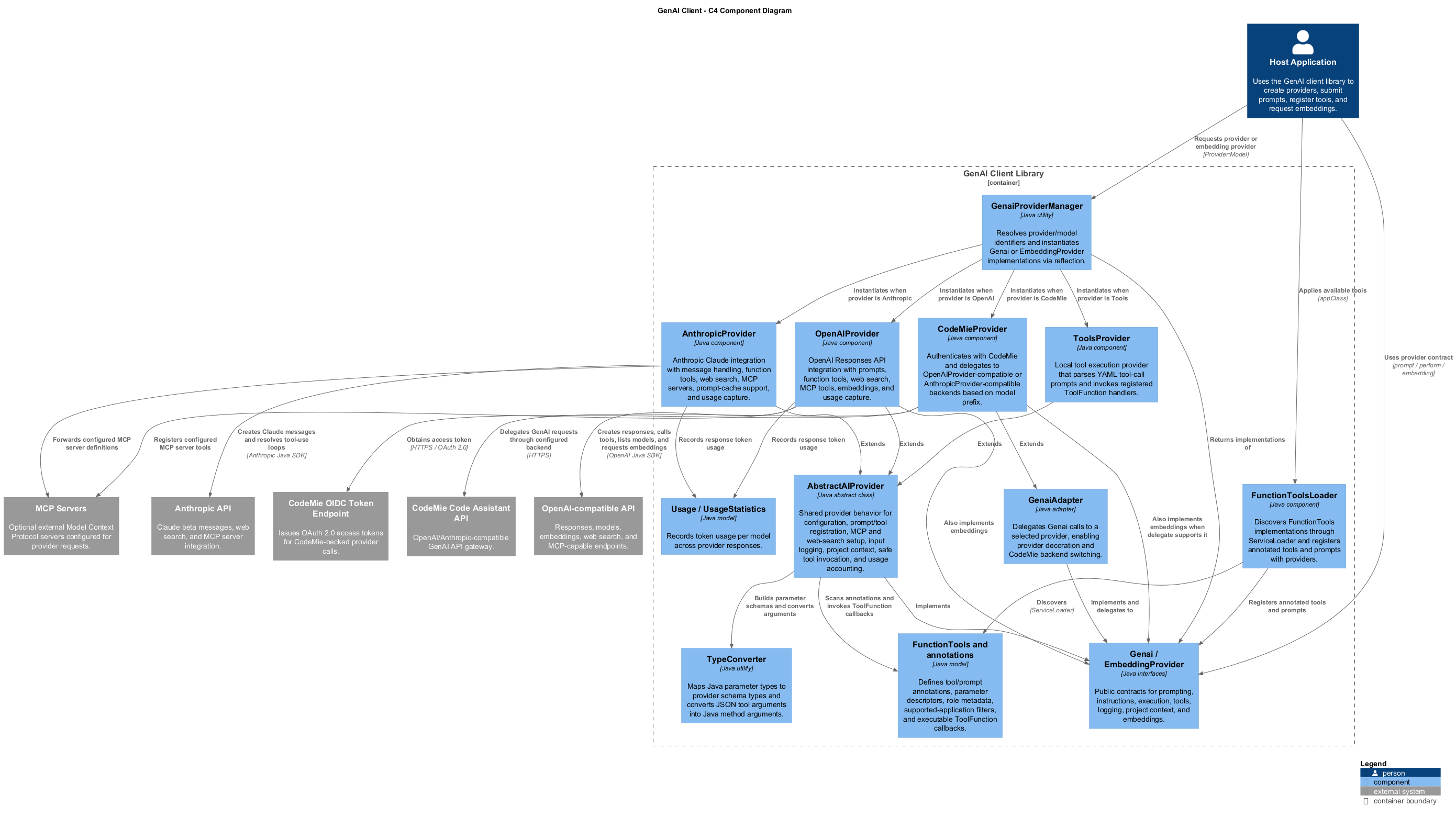
The main package areas are:
org.machanism.machai.process.managerresolves configured provider identifiers, initializes provider instances, and records token usage by model.org.machanism.machai.process.providerdefines the common provider contracts and reusable base behavior for conversational, embedding, tool-enabled, web-search-enabled, and MCP-enabled AI integrations.org.machanism.machai.genai.providercontains concrete provider implementations for OpenAI-compatible APIs, Anthropic Claude, and CodeMie, whileorg.machanism.machai.process.providercontains the direct host-side Tools and None providers.org.machanism.machai.process.toolsdefines tool, prompt, resource, parameter, role, and supported-application metadata, plus service loading and callback contracts used to expose Java methods as AI-accessible capabilities.
Supported AI providers
OpenAI
The OpenAI provider adapts the Machai ProcessProvider and EmbeddingProvider APIs to the OpenAI Java SDK Responses API and Embeddings API. It supports conversational text generation, iterative function-tool calling, optional OpenAI web search, MCP server tools, embeddings, request input logging, and OpenAI usage conversion.
Typical configuration includes an OpenAI API key, a chat or embedding model name, and optional values such as a custom OpenAI-compatible base URL, timeout, maximum output tokens, and tool-call limits. It can also be used with OpenAI-compatible endpoints by overriding the base URL.
Configure it with an identifier such as OpenAI:gpt-4o-mini or OpenAI:text-embedding-3-small, OPENAI_API_KEY, and, for a compatible gateway, OPENAI_BASE_URL. GENAI_TIMEOUT, MAX_OUTPUT_TOKENS, MAX_TOOL_CALLS, WebSearchTool.*, and MCP* settings are optional.
Anthropic
The Anthropic provider adapts the Machai ProcessProvider API to Anthropic Claude models through the Anthropic Java SDK Beta Messages API. It supports prompt execution, system instructions, custom function tools, automatic tool-use loops, optional web search, MCP server forwarding, prompt-cache control on the final registered tool, and token-usage capture.
Typical configuration includes an Anthropic API key or authorization token, a Claude model identifier, and optional values such as a custom base URL, timeout, output-token limits, web-search settings, and MCP server definitions. When local function tools are registered, the provider applies Anthropic ephemeral prompt-cache control to the final registered tool.
Configure it with an identifier such as Anthropic:claude-3-5-sonnet, ANTHROPIC_API_KEY, and optionally ANTHROPIC_BASE_URL, GENAI_TIMEOUT, MAX_OUTPUT_TOKENS, WebSearchTool.*, and MCP* settings. MAX_TOOL_CALLS is an OpenAI Responses API setting and does not limit Anthropic tool-use loops.
CodeMie
The CodeMie provider integrates with EPAM CodeMie Code Assistant endpoints. It authenticates with a CodeMie OpenID Connect token endpoint, obtains OAuth 2.0 bearer tokens, configures the delegated AI provider with the CodeMie API base URL, and routes supported model families to the appropriate implementation.
Models beginning with gpt-, gemini-, text-embedding-, codemie-text-embedding-, or amazon.titan-embed-text- are delegated to the OpenAI provider configured for CodeMie endpoints. Models beginning with claude- are delegated to the Anthropic provider. The provider supports password-grant and client-credentials authentication flows based on GENAI_USERNAME and GENAI_PASSWORD, with an optional AUTH_URL token-endpoint override.
Use an identifier such as CodeMie:gpt-4o-mini or CodeMie:claude-3-5-sonnet together with GENAI_USERNAME and GENAI_PASSWORD. A username containing @ selects the password grant; any other username selects the client-credentials grant. CodeMie supplies the delegated provider's base URL and bearer token, so callers do not configure OPENAI_API_KEY or ANTHROPIC_API_KEY directly.
Tools provider
The Tools provider exposes registered application functions for structured invocation. It collects prompts, registers ToolFunction callbacks, and executes those callbacks from YAML-based tool-call descriptions containing a tool name and parameter payload. This provider is useful for internal orchestration when host-defined tools need to be invoked through the same lifecycle as other AI providers without sending the request to an external model service.
Configure it with the Tools:yaml identifier. Register the local callbacks before calling perform() and supply the final prompt as the YAML tool-call descriptor; no external credentials or endpoint settings are used.
None provider
The None provider is a disabled, no-op implementation for configurations that must not make AI requests. It accepts the standard provider lifecycle calls, discards submitted state, and returns null from execution. Initialize it with the model name log to emit its implemented lifecycle activity at INFO level; other model names remain silent. It is useful as a safe default and in tests.
Configure it with None:log for INFO-level lifecycle diagnostics, or with another model value such as None:disabled for silent no-op behavior. It requires no credentials or endpoint settings.
Common configuration parameters
| Parameter | Description | Default value |
|---|---|---|
| Provider/model identifier | Model identifier used by the selected provider. ProcessProviderManager commonly resolves identifiers in the Provider:Model form, such as OpenAI:gpt-4o-mini; the provider itself receives the model portion. |
Required |
OPENAI_API_KEY |
API key for OpenAI or OpenAI-compatible endpoints. CodeMie sets this to the retrieved OAuth 2.0 bearer token for delegated OpenAI-compatible requests. | Required for OpenAI-compatible providers |
OPENAI_BASE_URL |
Optional base URL override for OpenAI-compatible APIs. | OpenAI SDK default |
ANTHROPIC_API_KEY |
API key or authorization token for Anthropic Claude requests. | Required for Anthropic |
ANTHROPIC_BASE_URL |
Optional base URL override for Anthropic-compatible APIs. | Anthropic SDK default |
GENAI_TIMEOUT |
Request timeout in seconds. A value of 0 or an absent value leaves SDK defaults in effect. |
0 |
MAX_OUTPUT_TOKENS |
Maximum number of tokens the model may generate. | 18000 |
MAX_TOOL_CALLS |
Maximum number of tool calls the OpenAI Responses API may issue in a response loop. A value of 0 leaves the limit unset. |
0 |
WebSearchTool.type |
Enables provider-specific web search when present. The value default maps to the provider default web-search tool type where supported. |
Not set |
WebSearchTool.city |
Optional city hint for web-search user location. | Not set |
WebSearchTool.country |
Optional country hint for web-search user location. | Not set |
WebSearchTool.region |
Optional region hint for web-search user location. | Not set |
MCP.url |
URL for the first MCP server tool. Additional servers can be configured with numbered groups such as MCP_1.url, MCP_2.url, and so on. |
Not set |
MCP.name |
Provider-visible MCP server name (passed to OpenAI as its server label). Additional servers can use MCP_1.name, MCP_2.name, and so on. A name is required for a configured group to be registered. |
Not set |
MCP.authorization |
Optional authorization value for the MCP server. Additional servers can use numbered variants. | Not set |
MCP.description |
Optional MCP server description. Additional servers can use numbered variants. | Not set |
GENAI_USERNAME |
Generic username used by provider authentication flows. CodeMie can use it for password-grant authentication. | Provider-specific |
GENAI_PASSWORD |
Generic password or secret used by provider authentication flows. CodeMie can use it as a password or client secret. | Provider-specific |
AUTH_URL |
Optional CodeMie OpenID Connect token endpoint override. | CodeMie default endpoint |