


Bindex Core


Introduction
Bindex Core is the library-indexing and library-discovery component of the Machai platform. It provides a consistent way to describe software libraries as structured Bindex metadata, validate and register that metadata, and retrieve suitable libraries for a natural-language development request.
The library combines schema-based metadata, generated embeddings, semantic vector search, classification filters, and a MongoDB-backed repository. Its Java API supports both application code and AI tool integrations: an AI agent can recommend libraries, inspect a complete or GraphQL-filtered descriptor, register metadata from JSON/files/URLs, and obtain the Bindex schema or generation prompt. This reduces duplicate implementation work, improves dependency selection, and makes reusable capabilities discoverable across projects.
Overview
A Bindex record captures a library's coordinates, version, purpose, classification, integrations, dependencies, examples, and configuration guidance. The workflow is:
- A library's documentation and build metadata are assembled into a schema-compliant descriptor.
- The descriptor's classification is converted into an embedding and stored with searchable metadata.
- A user request is classified by a configured GenAI provider and converted into a query embedding.
- Semantic search is narrowed by language and architectural layer, filtered by a score threshold, and reduced to the most useful version of each library.
- The selected descriptors can then guide implementation, assembly, or further dependency resolution.
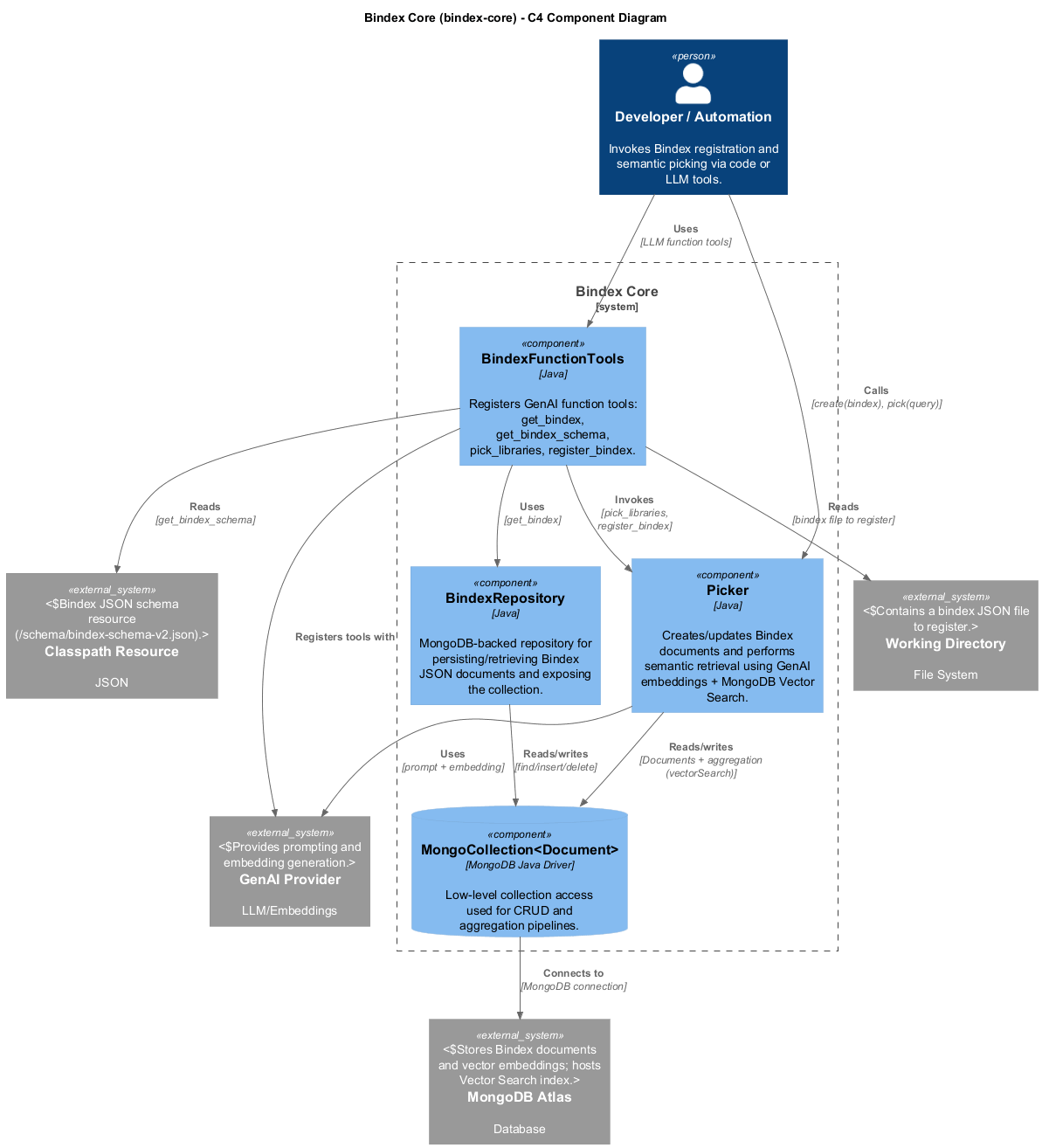
The architecture separates AI-facing tools from the domain workflow and persistence layer. Tool operations provide the external contract; a coordination service manages classification, embeddings, registration, and recommendations; a repository abstraction isolates persistence and vector queries; a MongoDB adapter supplies the concrete storage implementation; a JSON projection utility limits returned fields; and generated schema classes preserve a typed metadata model. The documentation covers the end-to-end indexing workflow, build integration, configuration, troubleshooting, and the available automation acts. The project structure is illustrated below.
Key Features
- Schema-compliant Bindex v2 metadata with practical installation and usage examples.
- Natural-language library recommendations powered by configurable GenAI and embedding providers.
- MongoDB persistence with exact vector search, classification filters, score thresholds, and version selection.
- Registration from a Bindex object, a project-relative JSON file, or a remote URL.
- Retrieval by coordinates or URL, with optional GraphQL-style field filtering to reduce response size.
- AI function tools for discovery, metadata access, registration, schema retrieval, and Bindex-generation prompts.
- Recursive dependency resolution and language-name normalization for reliable matching.
- Maven integration and an assembled artifact profile for distribution.
How to use
Bindex Core is assembled for use with the Bindex MCP Server. It is included by default in the Ghostwriter CLI.
If you use gw-maven-plugin, add Bindex Core as a plugin dependency:
<plugin>
  <groupId>org.machanism.machai</groupId>
  <artifactId>gw-maven-plugin</artifactId>
  <version>RELEASE</version>
  <!-- other plugin configuration -->
  <dependencies>
    <dependency>
      <groupId>org.machanism.machai</groupId>
      <artifactId>bindex-core</artifactId>
      <version>RELEASE</version>
    </dependency>
  </dependencies>
</plugin>
For direct Maven use, declare the dependency in the project that consumes the library:
<dependency>
  <groupId>org.machanism.machai</groupId>
  <artifactId>bindex-core</artifactId>
  <version>RELEASE</version>
</dependency>
The AI-facing operations are exposed as get_bindex, pick_libraries, register_bindex, and register_bindex_json. Configure the GenAI provider and embedding provider through the host application's Configurator; repository connections can be customized with the parameters listed below.
Built-In Acts
The following acts are defined under src/main/resources/acts/**/*.toml and support repeatable Bindex and implementation workflows.
assembly
Uses Bindex library recommendations to help an AI software engineer implement a user task. Use it when a task requires selecting existing libraries, creating or updating a project, building it, and documenting the result.
bindex
Coordinates Bindex generation for a non-parent Maven project. Use it to select the Maven project workflow, produce schema-compliant metadata from documentation and effective build information, validate the resulting descriptor, and register it.
bindex/java/extract-javadoc
Extracts a complete, standalone Markdown report from generated Java Javadoc HTML. Use it when API documentation must be supplied as authoritative input for Bindex generation, including class metadata, inheritance, constructors, methods, signatures, and member descriptions.
bindex/java/mvn-project
Builds Javadoc for a Maven project and uses the reports, site Markdown, effective POM, and generation rules to create and validate bindex.json. Use it as the Maven-specific implementation stage of the Bindex workflow.
bindex/register
Determines whether the current project is a supported non-parent Maven project and runs the registration stage of the Maven workflow. Use it to register an existing bindex.json; it stops for parent projects or unsupported project layouts.
bindex/validation
Validates a generated Bindex JSON descriptor for a non-parent Maven project by loading it through the Bindex tooling. Use it after generating or editing metadata to find validation errors and correct the descriptor before registration.
pick
Selects libraries relevant to a user's query through Bindex recommendations. Use it when planning a new implementation or extending an existing project and suitable reusable libraries need to be identified before coding.
Configuration
| Parameter | Description | Default value |
|---|---|---|
gw.model |
GenAI model used by the picker when pick.model is not set. |
CodeMie:gpt-5.4-2026-03-05 in the pick and assembly acts; otherwise host/application-defined. |
gw.mini.model |
Compact GenAI model used by the Bindex generation and registration acts. | CodeMie:gpt-5.6-luna-2026-07-09 in the Bindex acts. |
pick.model |
Model override used specifically for classifying library-selection requests. | Falls back to gw.model. |
embedding.model |
Embedding provider model used to encode classifications for semantic search. | CodeMie:text-embedding-005 in the pick, assembly, and Maven Bindex-generation acts; otherwise host/application-defined. |
pick.score |
Similarity threshold used by the library-picking act when selecting recommendations. | 0.86 in the built-in pick and assembly acts. |
picker.classificationInstruction |
Custom instruction template for producing classification JSON; it receives the classification schema and user query as format arguments. | Built-in classification instruction. |
gw.path |
File glob used by an act to select the project files it processes. | glob:. for the Bindex generation acts. |
BINDEX_REPO_URL |
MongoDB connection URI for the Bindex repository. | mongodb+srv://cluster0.hivfnpr.mongodb.net/?appName=Cluster0. |
BINDEX_USER |
MongoDB username when authentication is required. | Not set; when the default URI is used and both credentials are unset, the repository uses user. |
BINDEX_PASSWORD |
MongoDB password used to authenticate to the repository. | Not set; when the default URI is used and both credentials are unset, the repository uses user. |
vectorSearchLimits / search_limits |
Maximum number of vector-search candidates or recommendations. | 25 for the AI tool. |
score |
Minimum semantic similarity score for returned recommendations. | 0.85 for the AI tool. |
Troubleshooting
If Java cannot access the JDK DNS implementation while starting the application, add the following JVM argument to the Java startup command or configure it through the environment used to launch Java:
--add-exports jdk.naming.dns/com.sun.jndi.dns=java.naming
Also verify that the configured MongoDB URI and credentials are reachable, that the embedding model produces vectors compatible with the repository's vector index, and that the Bindex descriptor validates against the Bindex v2 schema.